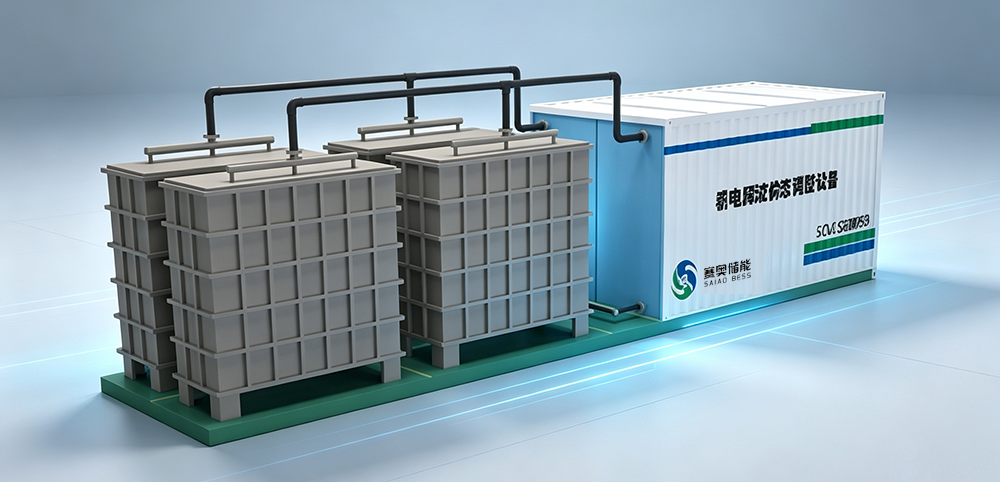
▲Hangzhou SaiAo Energy Storage Equipment Co., Ltd.
Specialist in vanadium‑electrolyte state‑adjustment equipment & system‑level solution services
Tel: +86 18857898829
How Is Vanadium Electrolyte Produced? A Complete Overview of Two Main‑Stream Processes
Electrolyte accounts for more than half (approximately 52 %) of the total cost of an all‑vanadium redox flow battery (VRFB). At the heart of this major cost component lies one core objective: to reduce the inherently stable pentavalent vanadium into mixed‑valence electrolyte suitable for battery operation without introducing impurities.
There are two dominant industrial routes, both adopting a “reduction + electrolysis” combined workflow: chemical‑reduction‑plus‑electrolysis, and short‑process‑plus‑electrolysis. Electrolytic reduction is an indispensable final step for both approaches; its practical implementation will be covered separately later. Today we break down each route to understand exactly how vanadium electrolyte is manufactured.
1. First Things First: What Exactly Are We Producing?
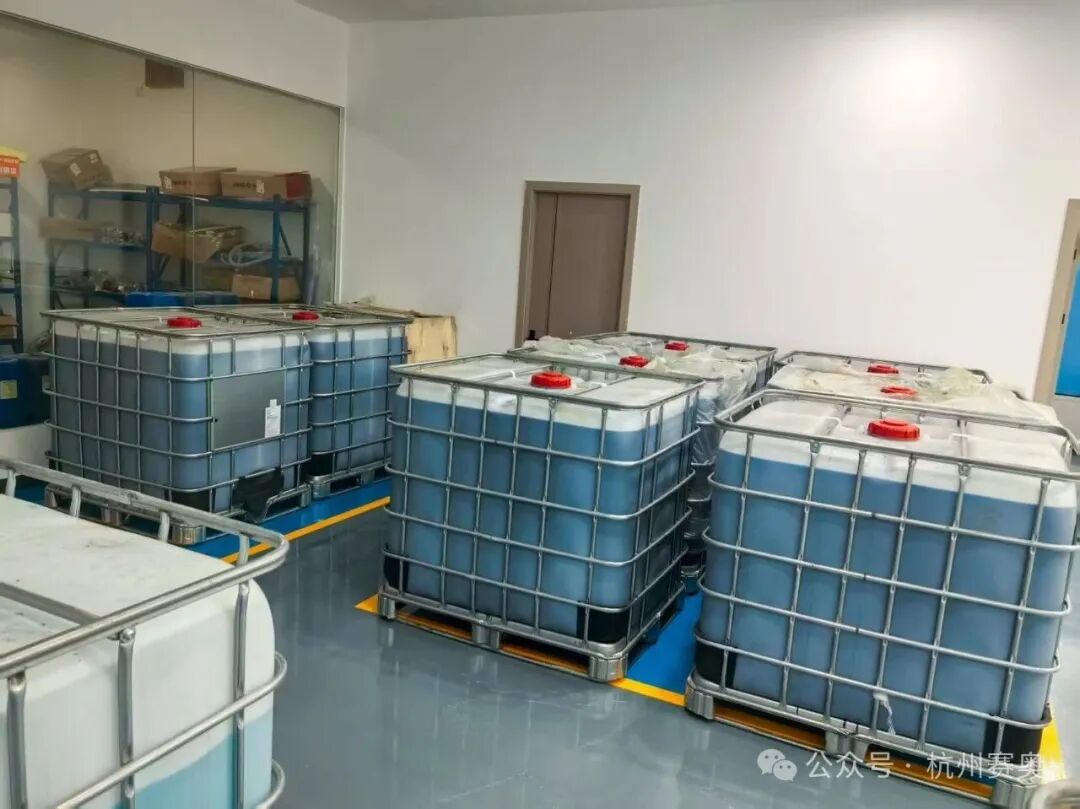
Vanadium electrolyte consists of vanadium ions plus supporting electrolyte. Sulfuric‑acid‑based supporting electrolyte is the most widely‑adopted system at present. The battery stores energy via reversible redox reactions of vanadium ions at different valence states: the positive electrode relies on the V(Ⅳ)/V(Ⅴ) redox couple, and the negative electrode uses the V(Ⅲ)/V(Ⅱ) couple.
The “3.5‑valent electrolyte” is the dominant industrial product. It is an equal‑molar mixture of V³⁺ and VO²⁺ and can be used for both positive and negative electrodes, which makes it highly popular. The Chinese national standard GB/T 37204‑2018 specifies clear requirements for its composition, valence‑state ratio and impurity content.
The core challenge of synthesis lies in the fact that pentavalent vanadium is the most thermodynamically stable form in nature, whereas the electrolyte requires the 3.5‑valent mixed state. Therefore, reducing pentavalent vanadium without introducing impurities is the central task for vanadium‑electrolyte preparation.
2. Process 1: Chemical Reduction plus Electrolysis
Principle: First, dissolve V₂O₅ in concentrated sulfuric acid. A reducing agent is added to reduce pentavalent vanadium to tetravalent vanadium (vanadyl sulfate, VOSO₄), followed by electrolytic reduction to obtain the 3.5‑valent state. Taking oxalic‑acid reduction as an example, the essential reaction in solution is shown below:
Oxalic‑acid reduction (pentavalent → tetravalent):
\(\ce{2VO2+ + H2C2O4 + 2H+ → 2VO^2+ + 2CO2 ^ + 2H2O}\)
Process route “chemical reduction‑electrolytic reduction”: reduce to tetravalent state by oxalic acid → further reduce to 3.5‑valent state via electrolysis. Featuring mature technology and a simple workflow with purchased high‑purity V₂O₅, this is currently the dominant manufacturing process.
Advantages: Simple equipment, proven and reliable technology, suitable for large‑scale production.
Disadvantages: High‑purity V₂O₅ feedstock is expensive and in limited supply; slow reduction rate and difficult end‑point control; reducing agents tend to introduce impurities; acid mist is generated during high‑temperature dissolution.
3. Process 2: Short‑Process plus Electrolysis
Principle: Vanadium‑containing leachate is directly adopted as raw material. Through the sequences of “reduction‑extraction‑stripping” or “extraction‑reduction‑stripping”, high‑purity electrolyte is obtained while purification is realized. This greatly shortens the process flow and reduces reliance on high‑purity V₂O₅.
Advantages: Wide raw‑material sources (vanadium‑extraction leachate can be directly used); high product purity; short process flow, low cost, and feasibility for continuous and automated production.
Disadvantages: Extractant is prone to emulsification; oil‑removal treatment is required; complex wastewater treatment; impurity ions may still enter the final product.
Industry note: The short‑process route of “pre‑purification — reduction — extraction” developed by the Institute of Process Engineering, Chinese Academy of Sciences eliminates the intermediate step of high‑purity V₂O₅. It achieves roughly 30 % cost reduction and zero ammonia‑nitrogen wastewater discharge. A 1500 m³/year demonstration production line has been built, and Chuanfa Xingneng has constructed a 60 000 m³/year production line.
4. The Electrolysis Step: Stack‑Based Method vs. Electrolytic‑Cell Method
Both the chemical‑reduction‑plus‑electrolysis and short‑process‑plus‑electrolysis routes require a final electrolytic‑reduction step to convert tetravalent vanadium into 3.5‑valent electrolyte suitable for battery application. How is this step practically implemented? Two main technical approaches are available: using a battery stack or an electrolytic cell.
Stack‑Based Method: Operate directly with an all‑vanadium redox flow battery stack. Tetravalent vanadium electrolyte is fed into both the cathode and anode compartments. At the cathode, tetravalent vanadium is reduced to 3.5‑valent vanadium electrolyte. At the anode, tetravalent vanadium is oxidized to 4.5‑valent electrolyte. The 4.5‑valent electrolyte is further reduced back to the tetravalent state and recirculated to the cathode for reuse.Advantages: low capital cost and low energy consumption.Disadvantages: low production efficiency; the stack is prone to clogging and other malfunctions.
Electrolytic‑Cell Method: The cathode compartment of the electrolytic cell is filled with tetravalent vanadium electrolyte, while the anode compartment contains sulfuric‑acid solution. Vanadium electrolyte is directly produced on the cathode side.Advantages: high production throughput, simple operation, high current efficiency.Disadvantages: high capital cost and high energy consumption.
Route Selection: Each approach has its own pros and cons. The stack‑based method features low cost and low energy consumption yet suffers from low efficiency and frequent faults. The electrolytic‑cell method delivers high throughput and easy operation but comes with higher cost and energy use. Since the short‑process route is inherently continuous, it matches well with the high‑production‑throughput and high‑current‑efficiency characteristics of the electrolytic‑cell method. Consequently, the electrolytic‑cell method is more commonly adopted for integration with the short‑process workflow.
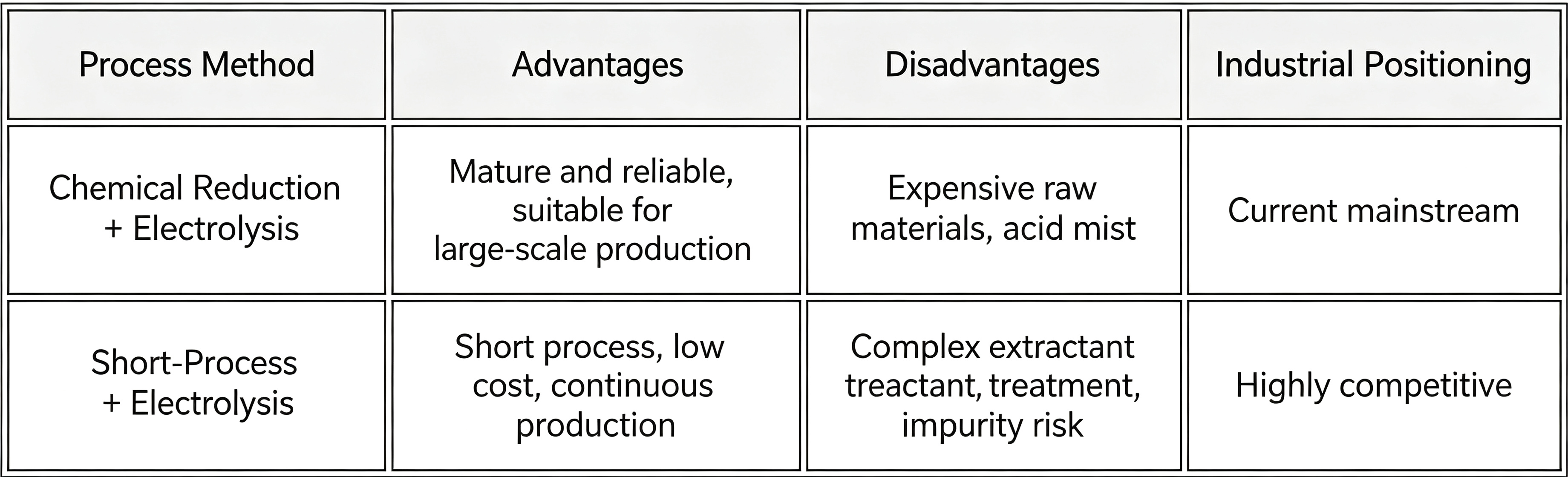
5. Comparison Overview of the Two Main‑Stream Processe
6. Concluding Remarks
For the industrial production of 3.5‑valent electrolyte, the mainstream adopts a combined “reduction + electrolysis” scheme. The chemical‑reduction‑plus‑electrolysis route is mature, reliable and currently dominant; the short‑process‑plus‑electrolysis route features a streamlined workflow, low cost and strong competitiveness. For the electrolysis stage of both routes, two technical options are available: the stack‑based method and the electrolytic‑cell method. The stack‑based method delivers low capital cost and low energy consumption, while the electrolytic‑cell method achieves high production throughput and high current efficiency. The suitable option can be selected according to local conditions.
Future development priorities lie in short processes, low cost, green production free of ammonia‑nitrogen discharge, and wide‑temperature‑range high‑concentration electrolyte.
References
[1] ASIACHEM Consulting. In‑depth Analysis of Industrial Vanadium Electrolyte Production Technologies: Which of the Three Processes Will Lead the Race? WeChat Official Account “ASIACHEM Energy Storage”, 2025‑07‑09.[2] Hanwei Wen, Guohua Ye, Junshu Wang, et al. Research Status and Prospect of Electrolyte Technology for All‑Vanadium Redox Flow Batteries[J]. Nonferrous Metals (Extractive Metallurgy), 2026(3): 493‑502. DOI:10.20237/j.issn.1007-7545.2026.03.004.[3] Public online resources: aibangfb, Composition and Preparation Methods of All‑Vanadium Redox Flow Battery Electrolyte (Including Layout Enterprise Directory); esplaza, Research Status and Prospect of Electrolyte Technology for All‑Vanadium Redox Flow Batteries; Guo Y., et al., review article in Journal of Industrial and Engineering Chemistry (including the ion‑exchange method), etc.[4] Vanadium electrolyte state‑adjustment equipment introduction, shturl.cc/zIQJ.




 浙公网安备33010502013592号