Times:2026-08-17 16:20 Popularity:69
Suitable for Organic Electrosynthesis · Redox Coupling Reactions
This distinctive “thin-film electrolysis” mode can markedly reduce the ohmic drop of electrolyte, improve current efficiency and product yield. It is especially suitable for special redox reaction systems with low electrolyte consumption or requiring no supporting electrolyte at all, making it an ideal piece of equipment for organic electrosynthesis.
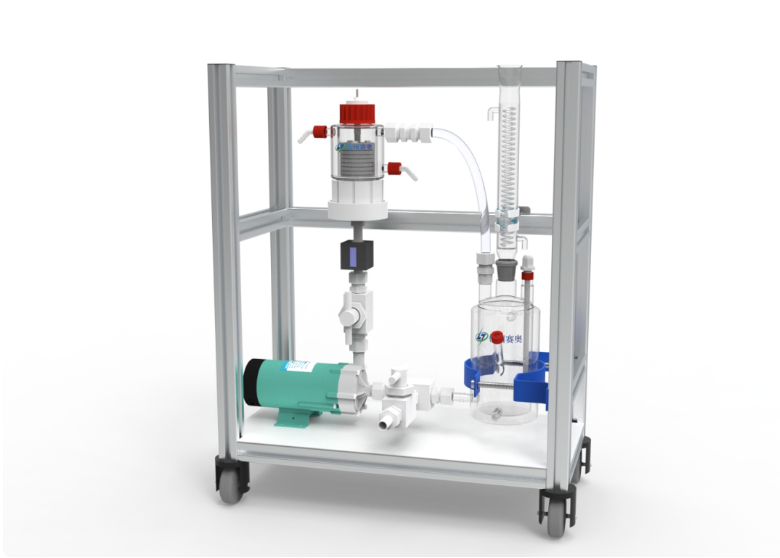
▲ Schematic Diagram of Capillary Gap Cell
1
Small inter-electrode spacing, drastically reducing electrolyte consumption
The electrode gap can be as low as 0.2 mm with precise adjustability. The electrolyte covers the electrode surface in the form of a thin film. Under identical reaction conditions, electrolyte consumption can be reduced by several times compared with conventional electrolytic cells.
2
Sufficient effective electrode reaction area for superior space-time yield
It adopts a stacked series configuration of graphite electrodes, with a total effective electrode reaction area of approximately 200 cm². Its productivity per unit reactor volume is markedly superior to that of conventional electrolytic cells.
3
Excellent mass transfer conditions facilitate the regulation of reaction selectivity
The electrolyte flows in a forced thin-layer circulation within the narrow gap to intensify mass transfer. The residence time of reactants on the electrode surface is controllable, enabling precise tuning of reaction selectivity and product distribution.
4
Markedly reduced ohmic drop and improved electric energy utilization efficiency
The ultra-small electrode spacing greatly reduces electrolyte resistance. The reaction voltage of a single cell is ~4 V, so more energy is directed to the target reaction, yielding a notable improvement in electric energy utilization efficiency.
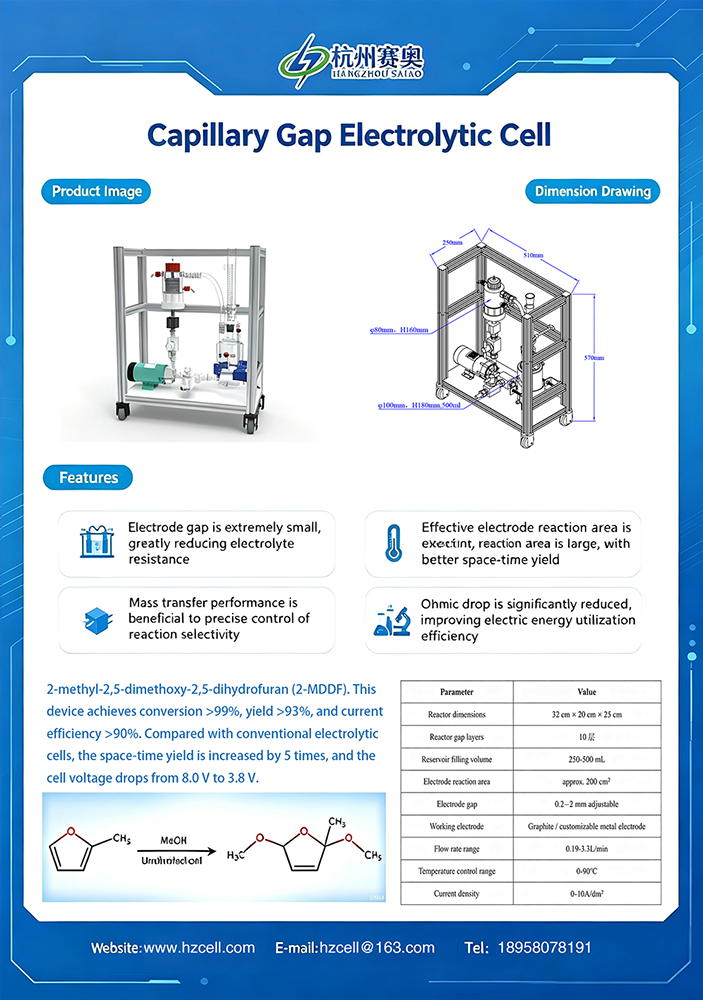
Electrooxidation of 2-methylfuran for the synthesis of 2-methyl-2,5-dimethoxy-2,5-dihydrofuran (2-MDDF). This device achieves conversion >99%, yield >93%, and current efficiency >90%. Compared with conventional electrolytic cells, the space-time yield is increased by 5 times, and the cell voltage is reduced from 8.0 V to 3.8 V.
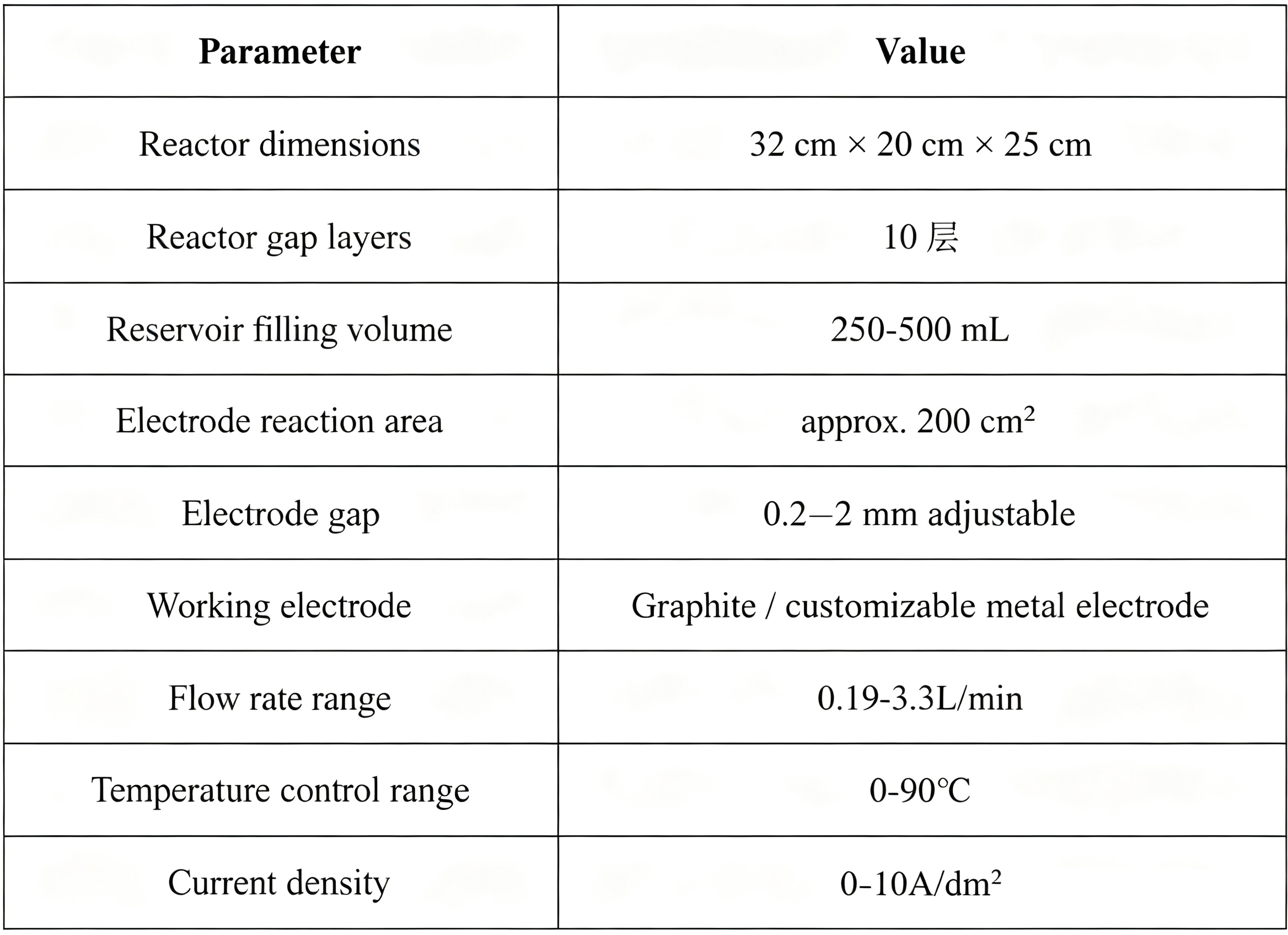
(1) The reactor is pre-assembled at the factory and ready for operation upon unpacking.
(2) The angled-neck design of the glass circulation bottle facilitates real-time sampling during reactions.
(3) The main reactor body can be disassembled as a whole for easy cleaning and electrode replacement.
(4) PTFE ferrule quick-connect fittings are adopted for pipelines, enabling tool-free assembly and disassembly.
(5) Integrated aluminum alloy frame equipped with casters for flexible movement and saving bench space.



Copyright © 2026-2027 Hangzhou Saio Electrolytic Technology Co., Ltd. All rights reserved
Address: Room 1503-8, Building 1, Haozhang Building, Gongshu District, Hangzhou City, Zhejiang Province

 浙公网安备33010502013592号