Times:2026-09-01 15:10 Popularity:87
The core of the electrochemical chlorine generator is to electrolyze sodium chloride solution with direct current to produce chlorine gas directly at the anode.
Main anode reaction:2Cl⁻ → Cl₂↑ + 2e⁻
Cathode reaction:2H₂O + 2e⁻ → H₂↑ + 2OH⁻
Anode side reaction: 2H₂O → O₂↑ + 4H⁺ + 4e⁻
To avoid mixing of generated chlorine and hydrogen gas — which compromises gas purity and creates explosion hazards — the equipment uses a perfluorosulfonic acid cation exchange membrane (Nafion 117) to separate the anode and cathode compartments, permitting only \(\boldsymbol{Na^+}\) to pass through. The anodic gas from electrolysis first undergoes dehydration via a spherical condenser (operating temperature: approx. 12–15 °C; temperature can drop to -5~5 °C in the purification stage). It is then dried by a Drechsel gas washing bottle filled with concentrated sulfuric acid, yielding dry chlorine gas with a purity of approximately 98.67%.
In short: The raw materials are only sodium chloride, water and electricity. Chlorine can be generated on demand upon power-on, realizing true on-site generation.
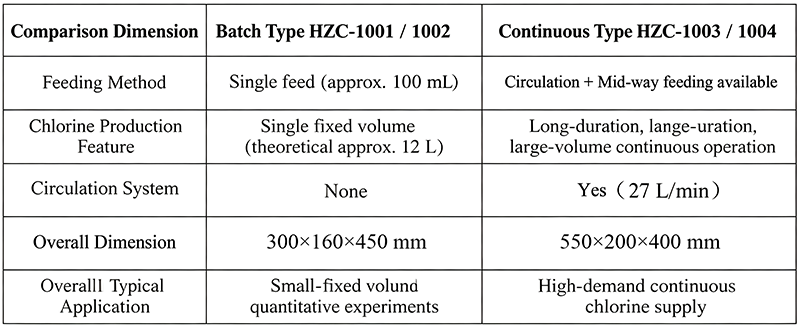
This series of equipment consists of an electrolyzer system, power supply system, feed-in & discharge system, drying-absorption system and gas alarm system. The main electrolyzer adopts polytetrafluoroethylene (PTFE) frame plates and titanium steel panels, with a temperature resistance range of -20~160℃. The effective reaction area of the electrode is approximately 70×130 mm, and the ion membrane is Nafion 117 perfluorosulfonic acid cation exchange membrane. Based on feeding and operation modes, the products are divided into two types:
1.Batch type: one-time feeding for quantitative chlorine generation;
2.Continuous type: circulating feeding with raw material replenishment, suitable for long-duration chlorine production.
The batch-type model adopts a non-circulating flow system. One single feed charge completes one chlorine generation cycle with a relatively fixed total chlorine output, making it suitable for single-run, quantitative and small-batch experimental requirements.
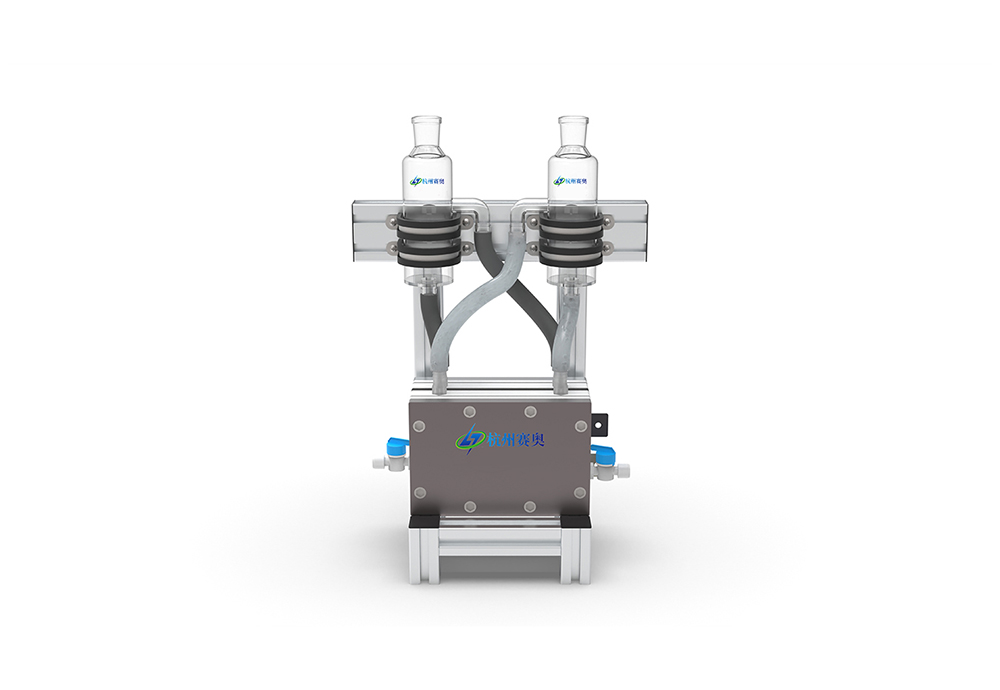
▲ Schematic Diagram
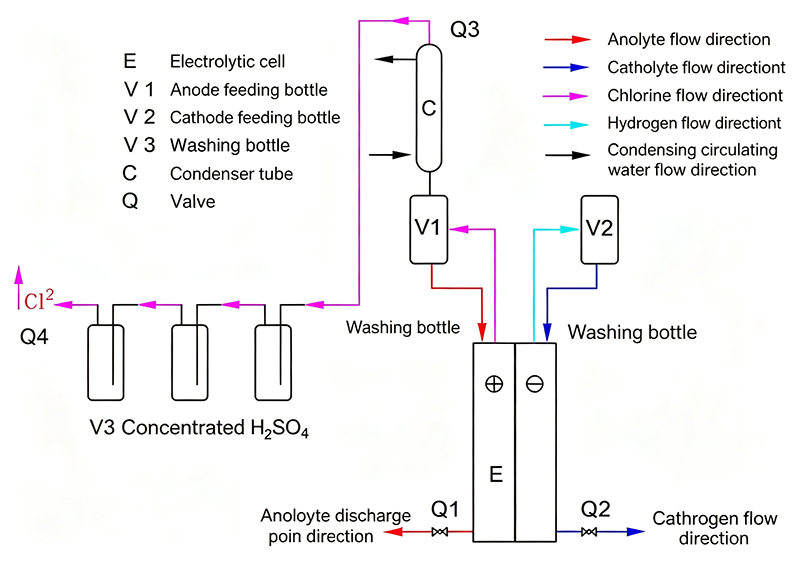
▲ Flowchart
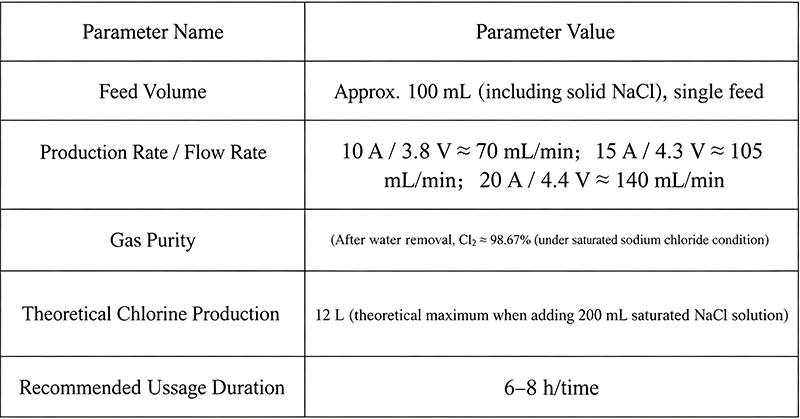
Brief Operating Procedure: Place the unit inside a fume hood and wear proper protective equipment. Add fresh saturated NaCl solution to the anode chamber, and 0.1 mol/L NaOH solution (or deionized water) to the cathode chamber. Preheat the power supply for 20 min, then circulate low-temperature medium (12–15℃) through the condenser. Gradually increase the current to the target value to start electrolysis and chlorine generation. Upon completion, cut off the current first, purge residual gas, and then drain and clean the cell.
The continuous-type model incorporates a corrosion-resistant magnetic pump circulation system on the basis of the batch-type unit. Solutions in the anode and cathode chambers circulate continuously with precise temperature control (the anode circulation bottle can be maintained at a constant temperature of approximately 60 ℃). Solid sodium chloride can be supplemented mid-operation, enabling long-duration, variable-rate continuous chlorine supply. It is better suited for experimental systems with high requirements on chlorine consumption and delivery continuity.
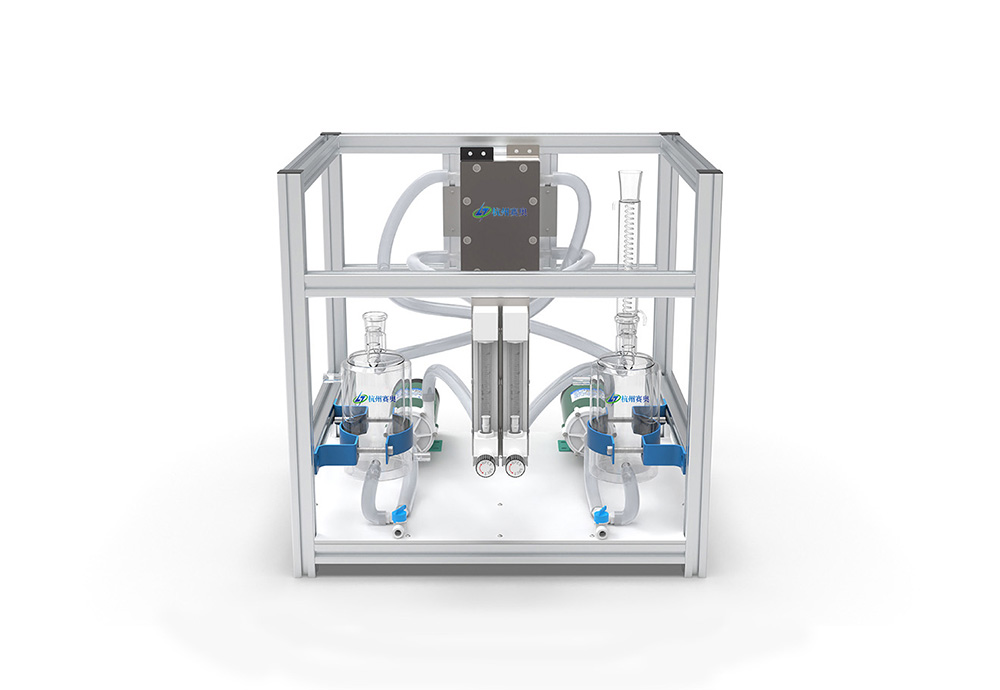
▲ Schematic Diagram
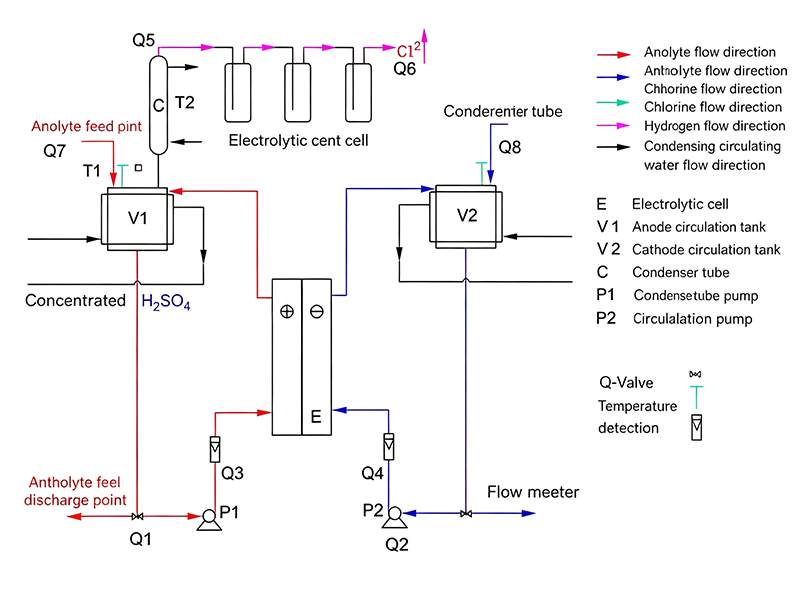
▲ Flowchart
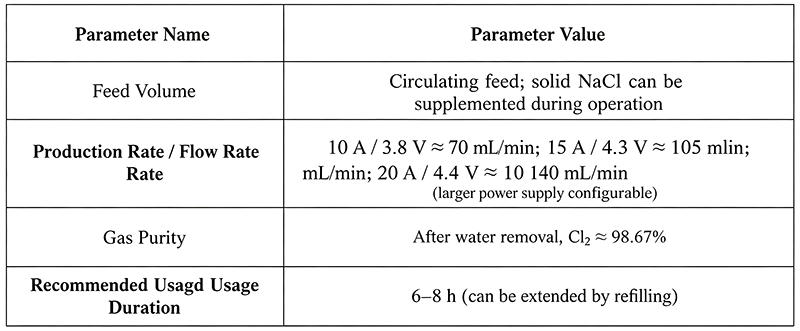
Brief Operating Procedure: Place the unit inside a fume hood and wear proper protective equipment. Perform a leak test with deionized water first, then purge air from pipelines using protective gas (nitrogen / argon). Fill the anode circulation bottle with saturated NaCl solution and add solid NaCl supplement; add deionized water or low-concentration NaOH to the cathode chamber. Turn on the circulation pump and stabilize the flow rate. After preheating, feed the cooling medium. Gradually raise the current to start electrolysis; raw materials can be supplemented at any time during operation. Upon completion, cut off the current, purge residual gas, drain and clean the system.
Universities and Research Institutes: Quantitative or continuous chlorine dosing in experiments of electrochemistry, organic/inorganic synthesis, catalysis and other fields.
Water Treatment and Disinfection: Small-scale disinfection experiments, research on residual chlorine and by-products, eliminating the burden of high-pressure cylinder procurement.
R&D in Chemical Enterprises: Lab-scale chlorination reactions and catalyst evaluation, supporting stable long-duration chlorine supply.
Teaching and Training: Intuitive demonstration of the principle of electrolytic chlorine generation. Safe and controllable, suitable for classroom teaching and practical training.
The electrochemical chlorine generator uses "sodium chloride + water + electricity" as raw materials. It simplifies the complicated workflow of chlorine supply — "cylinder procurement – approval – storage – utilization" — into an easy bench-top operation: power on and generate gas immediately. Whether you require small-batch quantitative chlorine generation or long-duration continuous chlorine supply, you can find a suitable model within the HZC series.
Hangzhou Saiao (www.hzcell.com) specializes in the R&D and manufacturing of electrochemical reaction devices, as well as the engineering of electrochemical synthesis and water treatment technologies. Supported by institutions including Zhejiang University of Technology, Nanyang Technological University and Scripps Research, our team possesses solid expertise in electrochemistry and rich experience in engineering implementation.
The company’s main products cover various electrolytic cells, lab-scale / pilot-scale electrolysis units and electrode materials. Customization of in-situ and special reactors is available, together with supporting services for electrochemical process development and scale-up. Our products are sold worldwide, serving leading enterprises such as Wanhua Chemical and Asymchem, alongside numerous research institutes and universities including the Chinese Academy of Sciences, Tsinghua University, Peking University and the University of Sydney.



Copyright © 2026-2027 Hangzhou Saio Electrolytic Technology Co., Ltd. All rights reserved
Address: Room 1503-8, Building 1, Haozhang Building, Gongshu District, Hangzhou City, Zhejiang Province

 浙公网安备33010502013592号