1 Overview
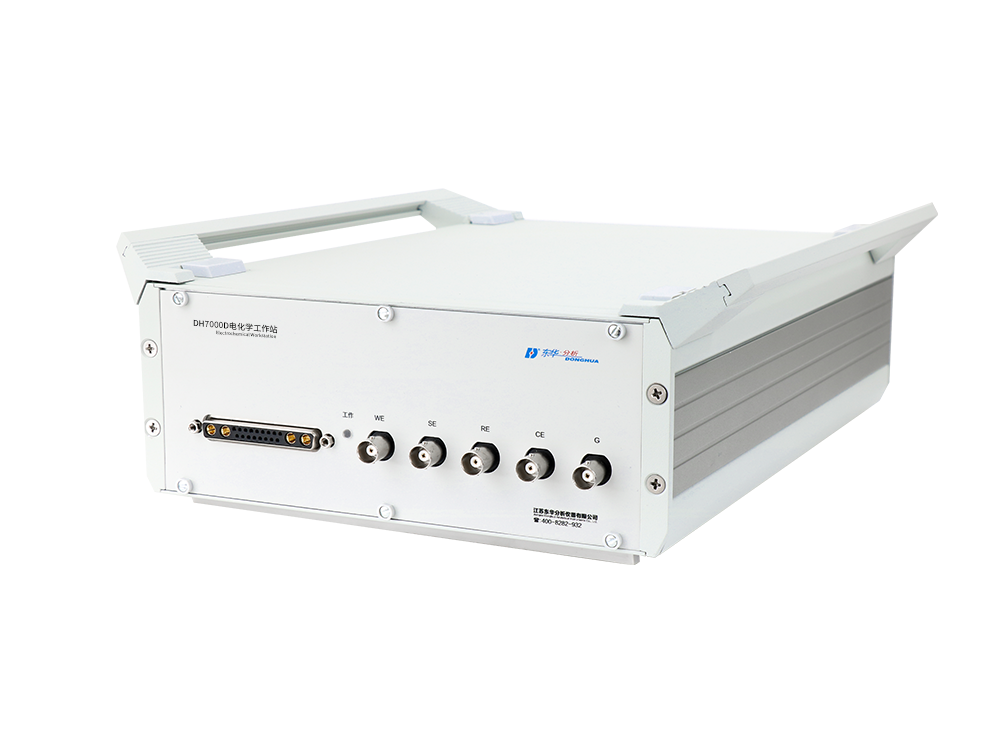
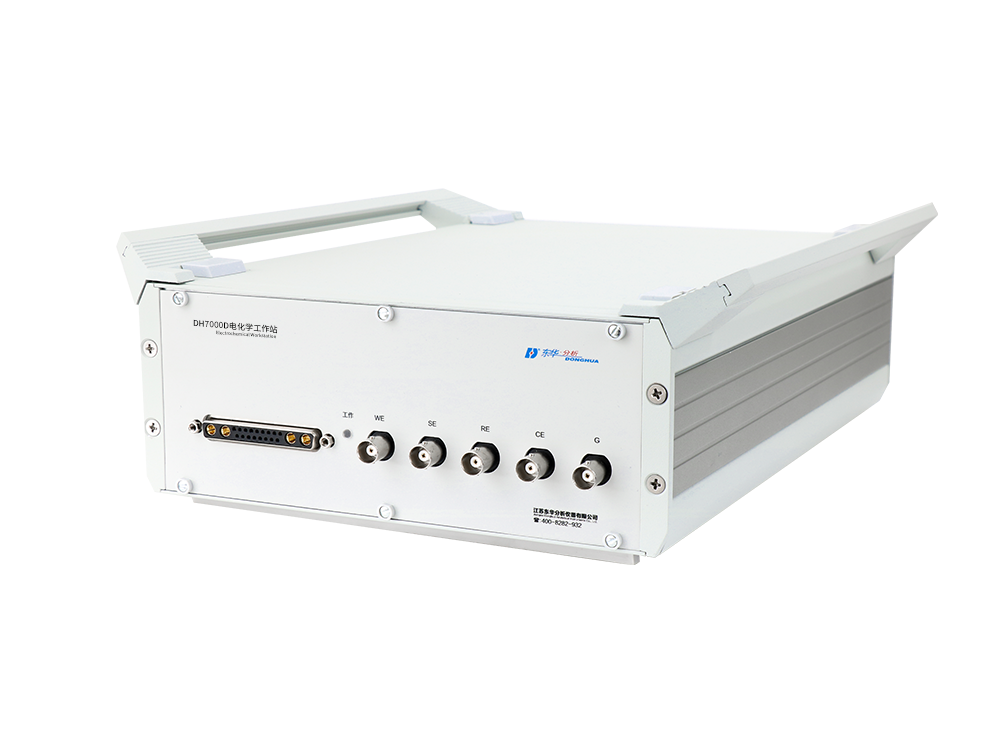
The DH7000C electrochemical test system consists of the DH7000C electrochemical workstation (potentiostat / galvanostat / AC impedance analyzer) and DH7000C control & data analysis software. The workstation integrates four core modules: electroanalysis, corrosion, AC impedance and energy modules. It is widely applied in electrode process research, chemical power sources, electroplating, electrolysis, phase analysis, metal corrosion research, electrochemical protection parameter measurement and other fields.
2 Application Fields
2.1 Electrochemical Analysis
Supports all conventional electroanalytical testing methods, including CV, LSV, CA, SWV, NPV, DPV, ACV, etc.
2.2 Corrosion & Protection Research
Covers full range of electrochemical tests for corrosion and protection research, including linear polarization resistance (LPR) and Tafel analysis to obtain parameters such as corrosion current, polarization resistance (Rp) and corrosion rate. Electrochemical impedance spectroscopy (EIS) tests under various polarization conditions are also available.
3. New Energy Research
Equipped with potential control and impedance modules, it realizes constant voltage, constant current, constant resistance and constant power charge-discharge tests with freely combinable charge-discharge functions. It meets test requirements for lithium batteries, fuel cells, supercapacitors and other new energy systems, enabling real-time monitoring and analysis of electrochemical reaction mechanisms.
2.4 Material Research
Compatible with multiple expandable power amplifiers and connectable to various external devices. Suitable for material performance studies, such as anti-corrosion coating evaluation, catalyst performance characterization, and performance testing of cathode and anode materials for lithium-ion batteries.
2.5 Biological Research
Compatible with various biological electrodes (enzyme electrodes, microbial electrodes, ion-selective electrodes and other modified electrodes). Applicable to biological enzyme catalysis, biological semiconductors, biofuel cells, biosensors, as well as biomedical testing, environmental monitoring, food and pharmaceutical analysis.
2.6 Teaching & Research
Over 80 built-in test methods to fulfill data acquisition and analysis requirements for electrochemical research and fundamental teaching experiments. The intelligent, user-friendly software features intuitive operation; complex experimental parameters can be configured in a few simple steps.
3 Functional Features
3.1 Constructed with high-quality integrated circuits, the system delivers high control precision, fast response, stable performance, compact structure and high automation. It adopts built-in high-speed controllers and high-precision 18-bit dual-channel AD converters for high-accuracy data acquisition, and communicates with PCs via Ethernet.
3.2 Equipped with high-speed data processors to deliver fast, high-precision electrochemical measurements. The instrument features simple installation and plug-and-play Ethernet connection with low startup costs. A high-speed DA board generates instantaneous current/voltage pulses and various complex electrochemical waveforms to realize fully synchronous voltage and current measurement. The four-electrode configuration enables flexible testing of high- and low-resistance electrolytic cells. State-of-the-art single-sine technique ensures consistent applied amplitude matching set values, maximizing test resolution under linear and stable conditions.
3.3 Powerful software with simplified experiment setup. Users can set up automatic batch potentiostatic / galvanostatic / impedance tests. Built-in functions include message prompts, external device linkage, data copy/paste and export. Data can be easily processed and exported to third-party analysis software. Multiple graphs and corresponding data can be displayed in one window. The embedded analysis module supports curve fitting: linear fitting, peak analysis, Rp polarization resistance fitting, Tafel fitting, EIS impedance data fitting, etc.
4 Technical Specifications
| Item | Parameter |
|---|
| Channel | Single channel |
| Output Voltage Range | ±21 V |
| Applied / Measured Potential Range | ±10 V |
| Applied / Measured Current Range | ±1 A |
| Applied Potential Accuracy | 0.1% FS ±1 mV |
| Applied Potential Resolution | ±100 mV (3 μV)±1 V (30 μV)±10 V (300 μV) |
| Measured Potential Accuracy | 0.1% FS ±1 mV |
| Measured Potential Resolution | 760 nV |
| Applied Current Accuracy | ±0.1% of reading |
| Applied Current Resolution | 1/30000 full scale |
| Measured Current Accuracy | ±0.1% reading ±1 pA |
| Measured Current Resolution | 8 fA (1 nA range) |
| Current Ranges | 1 nA ~ 1 A, fully auto-ranging |
| Potentiostat Bandwidth | 2 MHz |
| Slew Rate | 10 V/μs |
| Rise Time | ≤500 ns |
| Differential Electrometer Bandwidth | ≥10 MHz |
| Input Impedance | ≥10¹² Ω |
| Leakage Current | ≤1 pA |
| iR Compensation | Positive feedback or dynamic iR compensation |
| Impedance Frequency Range | 10 μHz ~ 1 MHz |
| Impedance AC Amplitude | 0.1 mV ~ 1 V RMS |
| Impedance Scan Mode | Linear or logarithmic |
| Electrode Connection | 2-electrode / 3-electrode / 4-electrode |
| Communication Interface | Ethernet |
| Power Supply | 220 V AC |
5 Operating Environment
Humidity: 0 ~ 80% RH
Optimal Ambient Temperature: 23 ℃




 浙公网安备33010502013592号